Certified Infoblox NIOS Integration: What It Means
NetBrain’s certification within the Infoblox Ecosystem validates secure, API-based integration with Infoblox NIOS. NIOS is Infoblox’s operating system for DNS, DHCP, and IP address management. It’s the core DDI platform.
In practical terms:
- Infoblox serves as the system of record for IPAM, DNS, and DHCP
- NetBrain acts as the system of reality, continuously validating live network behavior
Together, this creates synchronized operational intelligence across configuration, topology, and DDI data.

Key integration capabilities include:
- API-driven DDI discovery:
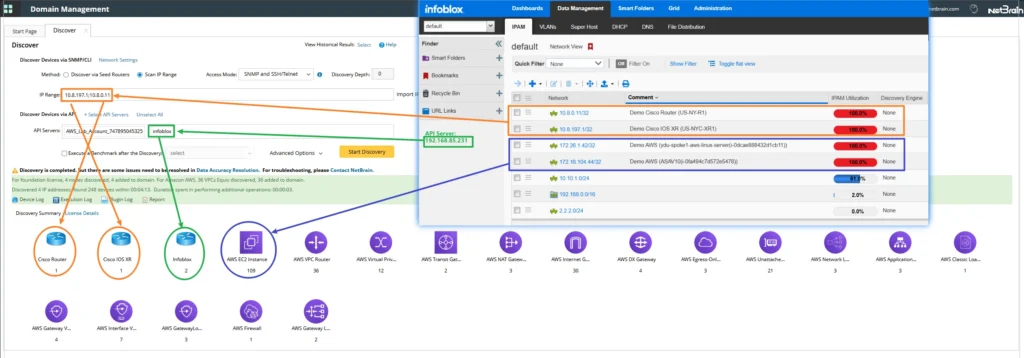
- NetBrain retrieves subnet, IP range, DNS, and DHCP data directly from Infoblox NIOS to seed and accelerate network discovery across hybrid environments.
- DDI-enriched topology and One-IP visibility:
- Network maps and IP-level views are dynamically enriched with Infoblox attributes such as hostname resolution and lease status, eliminating manual reconciliation between IPAM records and live infrastructure.
- Triggered automation with DDI validation:
- Runbooks and automated diagnostics can validate DNS, DHCP, and IP allocation state alongside network path and configuration analysis.
- Unified change correlation:
- Change analysis workflows correlate configuration modifications with Infoblox records to provide more complete impact visibility.
This integration allows teams to move beyond static configuration snapshots into continuous, real-time operational validation aligned with authoritative DDI data.
For NetMRI Customers: Expanding Beyond Basic Configuration Management
While NetMRI continues as a legacy-supported product focused on core configuration management, there is no active roadmap for expanded operational capabilities.
NetMRI has historically served as a network change and configuration management tool, offering:
- Network Discovery & Inventory – Automated device discovery and topology mapping
- Configuration Change Tracking – Logging and comparing device configurations
- Compliance Enforcement – Ensuring devices adhere to policy-driven rules
- Basic Automation Workflows – Scheduled scripts for repetitive network tasks
The Reality of Legacy NetMRI Environments
NetMRI has historically supported:
- Network discovery and inventory
- Configuration archiving
- Compliance enforcement
- Scheduled automation scripts
These functions remain valuable. However, modern hybrid and multi-vendor networks increasingly require:
- Continuous, real-time validation
- Automation that supports live incident response
- Proactive change impact analysis
- Integrated DDI context across workflows
NetBrain extends operational capabilities beyond basic configuration management, while preserving and enhancing existing Infoblox investments.
Modernizing NetMRI Environments with Expanded Automation and Real-Time Network Intelligence
Infoblox has confirmed that NetMRI will continue as a legacy-supported product. While there is no longer a formal end-of-life timeline, NetMRI remains limited in scope, with no new hardware, no active engineering investment, and no roadmap for expanded capabilities.
NetBrain enables Infoblox customers to expand into:
- Real-time digital twin visibility
- Intent-based validation
- Automated root cause analysis
- Hybrid cloud and multi-vendor coverage
- Change risk assessment before and after deployment
For organizations seeking to modernize network operations while maintaining Infoblox as their DDI foundation, NetBrain provides a certified and scalable path forward.
For Network Operations Teams Evaluating Their Next Step
Some organizations may choose to maintain NetMRI in its current form. Others are using this moment to assess how to modernize and reduce operational risk.
NetBrain supports multiple modernization paths:
- Coexistence alongside Infoblox NetMRI environments
- Phased expansion of automation capabilities
- Structured transition planning for teams choosing to evolve beyond legacy workflows
To help guide these conversations, NetBrain provides detailed technical resources outlining integration and modernization pathways.
 by
by